This article is guest authored by Martha Machia, VT Commodities Manager at Salvation Farms.
 Salvation Farms’ mission is to support a more sustainable agricultural system in the Northeast. We partner with other nonprofit organizations to accomplish this goal by working to identify new market opportunities for local farms. Farm to Institution New England (FINE) has made a constructive connection in this effort through a market development project called the Vermont Farm to Prison Project, launched in February of last year. The project partners include the Vermont Department of Corrections (DOC), food hubs including Green Mountain Farm Direct, and Food Connects, and processors like Salvation Farms (SF). This project is supported by FINE and funded by the Vermont Association of Agriculture, Food and Markets. Measurable success has occurred, with five new farms selling local goods to the DOC. An affordable means of introducing local produce into the institutional market is through bulk surplus crop purchases.
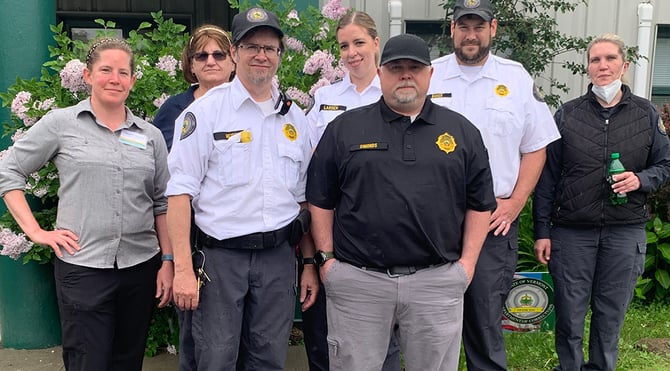
The sale of bulk amounts of local, fair quality produce to institutions presents challenges to prison food service operations, “What should we do with all of these vegetables?” Salvation Farms has the answer! SF agreed to provide technical assistance on how to manage large amounts of produce in institutional kitchens. In preparation, the DOC shared their year-round menu plans, and SF designed a workshop to train staff on minimal processing and preservation techniques that suit their needs. In June, Martha Machia from Salvation Farms lead a training at Northeast Correctional Facility in St. Johnsbury, VT. The foodservice supervisors from all six of Vermont’s prisons participated in the session. We practiced preservation methods that work great for zucchini, carrots, tomatoes, and cucumbers.
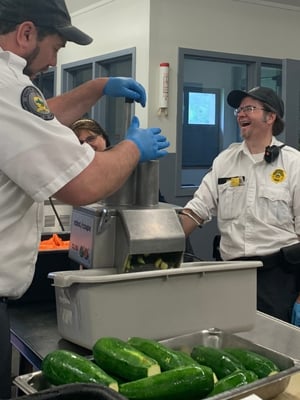
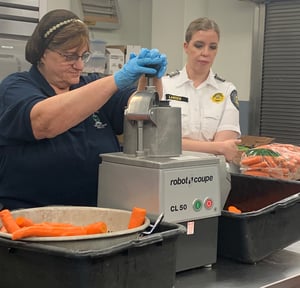 Zucchini is a nutritious and bountiful vegetable that stores well frozen. To prepare the zucchini, we used a food processor to dice it, portioned it into recipe quantities and then vacuum sealed it for long freezer storage. All Vermont DOC sites now have vacuum sealers for preserving food. Using a vacuum sealer requires some finesse, and we discussed the troubleshooting techniques that make packaging easy and efficient. When preserving carrots, blanching them before freezing cuts down on the cooking time during meal preparation and helps to retain color, flavor and nutritional value. Nothing beats the flavor of a carrot grown in the rich soil of Vermont! Through following these processing methods, the prepped vegetables are recipe ready. In addition to convenience, the frozen vegetables have no added sodium or artificial preservatives.
Vermont’s growing seasons are subject to high heat and greater rainfall amounts. Tomatoes ripen rapidly on the vine when the mercury rises, and farmers face a challenge in finding conventional market buyers for unpredictable amounts of ripe fruit. Thus, surplus tomato crops are available for bulk purchasing. With the limited shelf-life of fresh, ripe tomatoes, processing them for longer storage is necessary. Because the varieties of surplus tomatoes are often unsuitable for making sauces, we used an oven-drying technique. To oven-dry tomatoes, we quartered them and laid them out on sheet trays. Next, we loaded the trays into convection ovens at low heat and baked them for about an hour. The finished product has concentrated flavor and low-moisture content, making them perfect for freezing. We taste-tested the oven dried tomatoes tossed with oil, salt and pepper. Everyone agreed that the flavor was excellent!
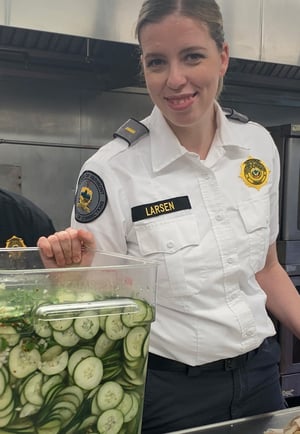 Field-grown cucumbers have growth spurts when the weather is especially hot and humid. These environmental factors cause the fruit to grow crooked or misshapen. Conventional market standards do not tolerate variances in appearance, which results in a locally-grown supply of fair quality cucumbers during the summer growing season. At the workshop, we practiced quick-brining cucumbers to make pickles. By slicing cucumbers in a food processor with a feed-tube, we prepped 30 pounds of them into uniform rounds in minutes. The main ingredient of the brine, distilled white vinegar, is an inexpensive preservative with minimal sodium content that is appropriate for the DOC’s dietary standards. We talked about what kinds of spices and herbs are already in use in DOC kitchens, and how to scale the recipe for including them. The refrigerated shelf life of the pickles is several weeks. After a taste test, the foodservice supervisors were certain that these fresh made pickles would be a hit in cafeterias.
The cooking workshop was a success on many levels. The DOC participants learned new ways to incorporate local, fresh vegetables in their operations through workable methods of replacing conventionally sourced ingredients. The side conversations we had will lead to more opportunities for buying fresh and sourcing local. Working together in the kitchen resulted in levity, closer relationships and the sharing of ideas. Salvation Farms is obliged and appreciative of our role in supporting the Vermont Farm to Prison Project. We look forward to the success of our combined efforts in partnership with Farm to Institution New England.
Are you a Vermont farmer or producer interested in selling to VT DOC? Contact FINE's Program Manager Britt Florio to set up a conversation! Brittany@farmtoinstitution.org
Follow the work of Salvation Farms